
















It was a case of deep mutual admiration when WA’s most esteemed child health champion and one of her high-flying students received honorary doctorates alongside one another at The University of Western Australia last night.
Distinguished medical researcher, public health advocate and 2003 Australian of the Year, Professor Fiona Stanley AC CitWA, was one of only a handful of female lecturers in medicine when she first encountered Annie Sparrow in her UWA class in the mid-1990s.
At the time, she was just one of many students Professor Stanley taught when she wasn’t busy heading up her pioneering child health research institute – now known as The Kids Research Institute Australia – or advocating for life-saving changes to public health policy.
It wasn’t until a few years later that the two crossed paths again.
By then Dr Sparrow was a respected paediatrician and intensive care specialist who had worked for several years in London before being lured back to WA to work in paediatric intensive care at Princess Margaret Hospital.
Despite enjoying the job, she had begun to shift her thoughts to refugee health following an eye-opening visit to war-torn Afghanistan, where her brother was working in humanitarian aid, and several spells volunteering at the Woomera immigration detention centre in remote South Australia.
Knowing she needed public health qualifications but unsure where to start, she called on her old lecturer – whose Institute was just across the road from PMH – for advice.
“I had to decide how to do this and there was no one else to advise me but Fiona,” Dr Sparrow says.
“There’s only a handful of people who are in a position to guide you at that level, and Fiona was not only right there, but made herself accessible.”
Professor Stanley encouraged her to look beyond Australia – Dr Sparrow had been looking at studying in Townsville or Melbourne – and undertake her Master of Public Health at Harvard University instead.
Dr Sparrow followed her advice and graduated from Harvard in 2004, going on to join Human Rights Watch as its first researcher with medical training. There, she met her husband – HRW head Kenneth Roth – and has since built a career advocating for refugees and human rights in some of the world’s most dangerous and marginalised places, including detention camps in war-torn countries such as Syria, Afghanistan, Sudan and Somalia.
Her research into sexual violence and war crimes in Darfur led to her being an expert witness at the International Criminal Court, and she has been unafraid to publicly call out the shortcomings of governments and humanitarian organisations during times of conflict and emergency.
Now based at the Icahn School of Medicine at Mount Sinai in New York, Dr Sparrow continues to travel the world as a paediatric intensivist and global health specialist.
She credits Professor Stanley, who has continued to mentor her throughout her career, with not only teaching her how to undertake rigorous research to inform her advocacy, but how to walk the line between being a troublemaker and diplomatically pushing for change.
“The thing about Fiona is she teaches you how to be an anthropologist and how to really listen to people,” Dr Sparrow says.
“She’s fearless – she provides a benchmark on how to get things done. She taught me how to make sure I have credibility and reputational rigour, and how to be an advocate with the kind of moral authority she is famous for. She showed me it can be done.”
Professor Stanley refuses to take much credit for Dr Sparrow’s success, saying she would always have been brilliant and was braver in some respects than Professor Stanley had been in her own passionate and outspoken career.
“I admire her enormously for it – she’s very much an international star in paediatric global health,” Professor Stanley says.
“She thinks I changed her life but the thing is she was going to be outstanding no matter what I did.
“I just did what mentors do – pointed her in the right direction and linked her up with people for her career. Now I’m linking young women up with her so she can mentor them.”
Professor Stanley acknowledges the powerful nature of being a female role model in a field that was for so long dominated by men, and of women helping women as they juggle families and successful careers while still looking after their own health and wellbeing.
“When I went through medicine there were only six women out of 80 students,” Professor Stanley says.
“When Annie went through there were many more women studying but few women teachers. I showed that women can get there.”
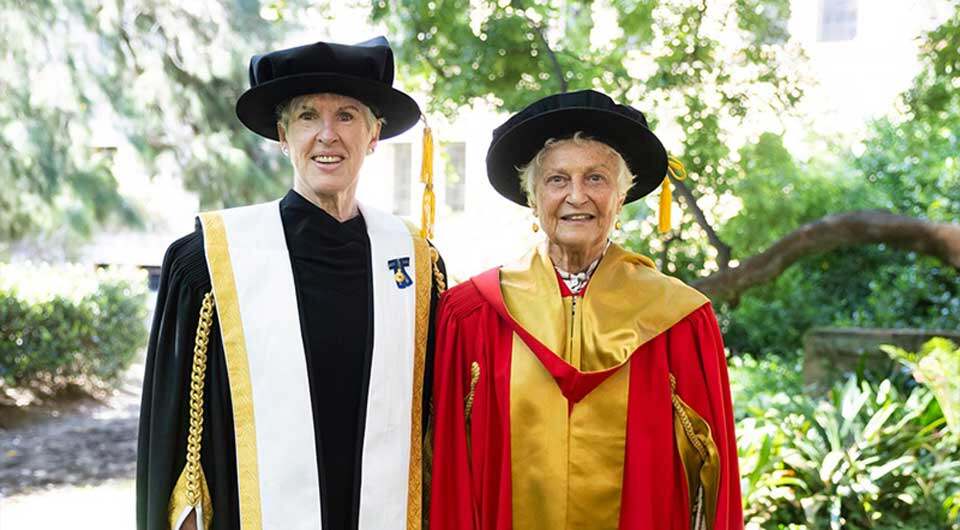
Last night, both women returned to UWA – each sharing the stage to be honoured for their respective careers.
Professor Stanley, who in 2004 was named a National Living Treasure, was awarded an Honorary Degree of Doctor of Science, while Dr Sparrow was awarded an Honorary Degree of Doctor of Medicine.
Professor Stanley says the recognition by her alma mater reminded her of the wonderful start she had had at UWA and the vital support the University had provided to The Kids Research Institute Australia during crucial stages of its history.
“That kind of collaborative support was fabulous,” she says.
Image above: Dr Annie Sparrow, left, with her mentor Professor Fiona Stanley