









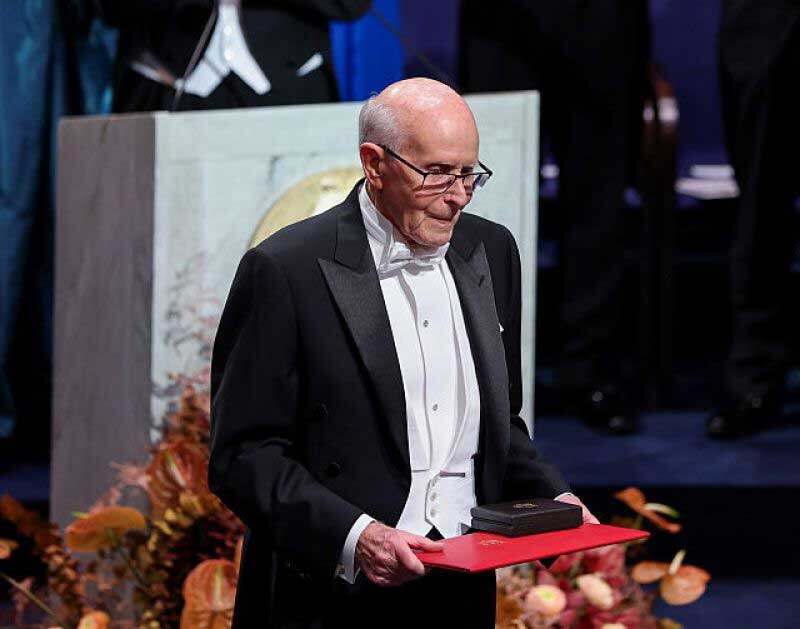
University of Melbourne Professor Richard Robson accepted his Nobel Prize in Chemistry from Swedish King Carl Gustaf XVI this morning in a glittering ceremony at the Stockholm Concert Hall.
Professor Robson was joined at the ceremony by his family, long-time colleague and friend Professor Brendan Abrahams and former PhD students, post-doctoral researchers and colleagues, who travelled from the United States, Denmark, UK and Australia to see their mentor receive chemistry’s highest honour.
“I’d like to thank my wife, my daughter, and my son for their love and support,” Professor Robson, from the Faculty of Science, said.

Professor Richard Robson with family members, colleagues and former PhD students and post-doctoral researchers at the Nobel Prize ceremony. Picture: Holly Watkins/University of Melbourne
“To my colleagues, Brendan Abrahams and the late Bernard Hoskins – who provided the real science and made my ideas possible.
“It’s a pleasure for me to see most of my PhD students and post-doctoral researchers from the 80s and 90s here in the room.”
Professor Robson smiled at the King as he shook his hand and accepted his Nobel medal and diploma.
He then bowed three times – first to the King and the Royal family, then to the Royal Swedish Academy of Sciences and finally, to the crowd where he was greeted with roaring applause.
Thirteen laureates received their Nobel Prizes in the fields of Physics, Chemistry, Physiology or Medicine and Literature.

Professor Robson accepts his Nobel Prize from King Carl Gustaf XVI. Picture Pascal le Segretain/Getty Images
Professor Robson shares his Nobel Prize with Professor Susumu Kitagawa, from Kyoto University, and Professor Omar M. Yaghi, from the University of California, Berkeley, for their development of metal-organic frameworks (MOFs).
Metal-organic frameworks are a new class of solids being developed into gas and energy storage devices, catalytic reactors, and other potentially revolutionary materials.
Addressing the winners, Professor Olaf Ramstrom, from the Royal Academy of Sciences and a member of the Nobel Committee for Chemistry, said: “You have made groundbreaking discoveries in chemistry that have led to the development of metal-organic frameworks. This is a truly great achievement for the development of mankind.”

Professor Richard Robson’s Nobel Prize diploma. The artwork is by Johan Sandell. Picture. Dan Lepp/The Nobel Foundation
Afterwards Professor Abrahams paid tribute to his long-time mentor.
“I have been very fortunate to work with Richard for the past 36 years,” Professor Abrahams said.
“You will struggle to find someone who’s more passionate about his research, dedicated to his teaching and generous with his time.
“I am delighted to witness this monumental occasion and see his seminal work receive the global recognition it deserves.”

Inside the Stockholm Concert Hall during the ceremony: Picture: Nanaka Adachi/Nobel Prize Outreach
The journey to the Nobel Prize started with a request to build large wooden ball and rod models of crystalline structures for giving first year chemistry lectures in 1974.
Professor Robson proposed replacing the balls with metal centres or multi-connected molecular units, and the rods with molecular bridges.
When he took his idea to the laboratory more than a decade later to test, he created a crystal with diamond-like connectivity, but more than half of its content was liquid.

Professor Richard Robson on stage at the Nobel Prize ceremony. Picture: Clement Morin/Nobel Prize Outreach
By replacing direct chemical bonds with molecular rods, Professor Robson introduced something completely new into these crystalline structures – space – which meant a substance could flow through a framework and be chemically transformed on the way through.
Professor Robson has described this time as a joy.
“I felt elation,” he said. “All of this was play, it was enjoyable. From the late ’80s to the 2000s when I retired, every day was terrific. Each morning, I couldn’t wait to come in.”

Professor Richard Robson delivering his Nobel Prize Lecture at the Aula Magna, Stockholm University. Picture: Nanaka Adachi/Nobel Prize Outreach
University of Melbourne Vice-Chancellor Professor Emma Johnston AO congratulated Professor Robson on this lifetime achievement.
“Professor Robson’s work is the type of long-term, curiosity-driven inquiry that pushes the boundaries of what we know and what we believe is possible,” Professor Johnston said.
“This kind of long-term fundamental research is what ultimately allows us to translate ideas into real-world impact – into products, technologies and capabilities that shape our future.
“In this case, it has enormous potential for sustainability and the energy transition due to the possibilities opened up by this research.
“Universities play a crucial role in fostering this type of blue-sky research. Professor Robson’s quiet dedication, perseverance, and endless curiosity embodies our academic mission.
“This is a proud day for the University of Melbourne community and for Australia as a nation. Professor Robson’s legacy will continue to inspire generations of scientists for years to come.”

Professor Robson signed a chair at the Nobel Prize Museum as part of the week’s events. Picture: Clement Morin/Nobel Prize Outreach.
Professor Robson has been a lecturer and researcher at the University of Melbourne since 1966.
Just hours after receiving the news that he had received a Nobel Prize in Chemistry, Professor Robson – who is 88 – was back in the classroom teaching first year Bachelor of Science students.
University of Melbourne Deputy Vice-Chancellor (Research) Professor Mark Cassidy said Professor Robson’s contributions to transformative research and teaching were extraordinary.
“Richard’s dedication to teaching, its nexus with research and his commitment to mentoring the next generation of scientists has been unwavering throughout his career,” Professor Cassidy said.
“As Australia’s leading research-intensive university, we are proud to support long-term fundamental research to advance the boundaries of knowledge and deliver innovative solutions to help solve the world’s most pressing challenges.
“It is an absolute honour to celebrate Richard, a treasured member of the University community who has devoted his life to seeking, expanding and sharing knowledge with his peers, students and the global community.”
Per tradition, the awarding of the Nobel Prize medal and diploma takes place on 10 December, the anniversary of the death of Alfred Nobel who, in his 1885 will, bequeathed his fortune to create the award.