






















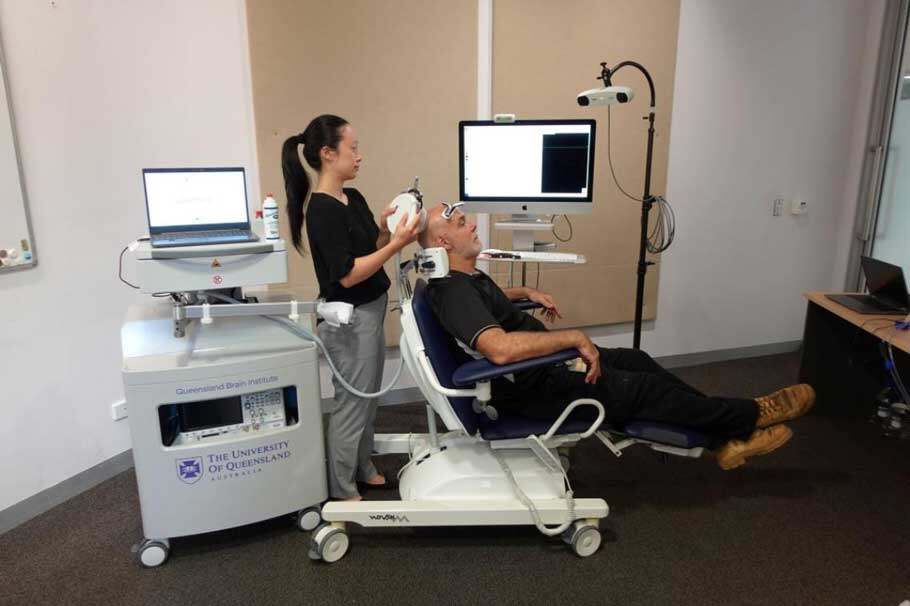
(Photo credit: The University of Queensland )
Scanning ultrasound to potentially treat Alzheimer’s disease has been found to be safe and well tolerated in a first-in-human pilot study conducted by University of Queensland researchers.
Key points
- The first-in-human pilot study found the ultrasound was safe and well tolerated in the 12 people who took part.
- There were encouraging signs the treatment may help with some of the behavioural problems that can emerge in Alzheimer’s disease, but further research is needed.
- The study was an important step in testing the new ultrasound device, and the next clinical trial is being planned.
Professor Peter Nestor from the Queensland Brain Institute’s Clem Jones Centre for Ageing Dementia Research said 12 people with Alzheimer’s were divided into groups to test different levels of ultrasound stimulation.
“We found it was fast, safe and well tolerated which is very encouraging and opens the door to further human studies,” Professor Nestor said.
Alzheimer’s disease is the most common form of dementia which currently affects more than 480,000 Australians and without significant scientific advances, it’s expected 6.4 million people will be diagnosed over the next 40 years.
“Although the aim of this study was to assess the safety of the technique, there were some encouraging signs that the treatment may possibly help with some of the behavioural problems that can emerge in Alzheimer’s disease, which will be explored in a new trial,” Professor Nestor said.
While too early to determine if the treatment was effective, Professor Jürgen Götz said some caregivers reported participants were less agitated.
“Further trials in a larger group of participants will be needed before we can draw any strong conclusions that scanning ultrasound can improve dementia symptoms,” Professor Götz said.
“The safety study was an important step in testing our new device to deliver the ultrasound, and now we are planning the next clinical trial.”
QBI researchers worked alongside design and engineering teams to develop the fit-for-purpose ultrasound device.
The research is published in Brain Communications.